AI Systems and Business Automation Newport Beach, California

Your team is doing work your software should be doing.

Veris AI designs and builds the automation, AI agents, internal software, data systems and reporting that take manual work off your team and make the business easier to run.

No cost, no pitch deck. We look at the operation first and identify where technology creates real leverage, and where it does not.

We connect the systems already around your business, and build the intelligent layer between them.

  • AI Automation
  • CRM Systems
  • Internal Tools
  • Data and Reporting
  • Business Workflows
  • Marketing Attribution

We don't start with AI.We start with the operation.

Most technology projects fail because the software is chosen before the business problem is understood. Veris maps how the work actually happens, identifies the bottleneck with the most leverage behind it, and builds the smallest system capable of solving it.

Selected work

Systems we designed and built, end to end

Each of these solves a specific operational problem for a specific kind of business. If one sounds close to yours, the pieces transfer.

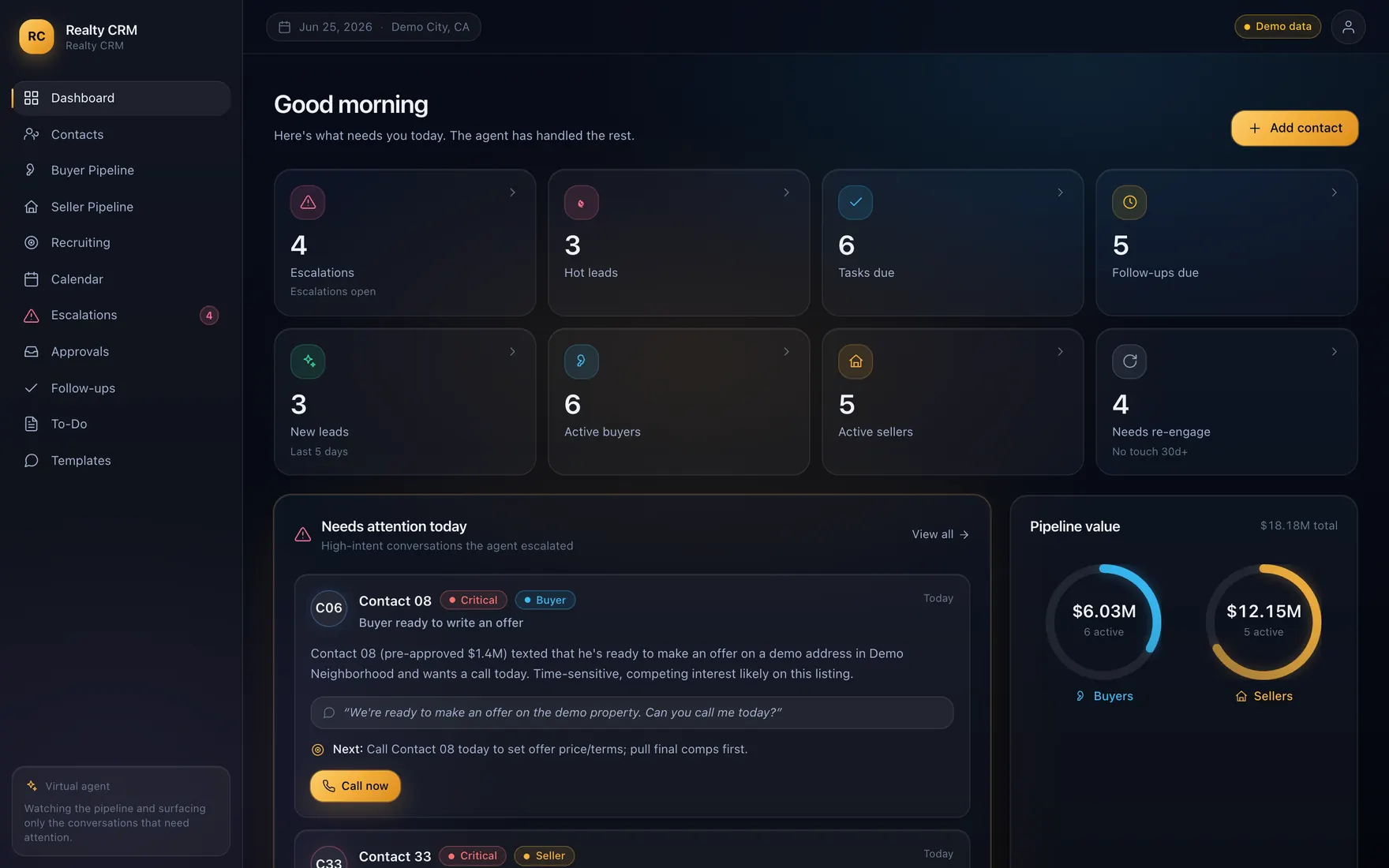
A CRM dashboard listing open escalations, hot leads, tasks due and follow-ups, with a panel of conversations flagged for a callback and two pipeline value dials.

Interface shown running on demo data

Sales operations

A pipeline that tells you who to call, instead of another list to read

Problem

Follow-up depended on human memory, spread across disconnected systems.

System

A unified CRM with an intelligence layer watching conversations, priorities, tasks and pipeline activity underneath it.

Outcome

Time-sensitive opportunities surface on their own, with the reason attached and a recommended next action. Everything else stays handled and out of the way.

Explore system
  • Next.js
  • Supabase
  • Cloudflare
  • AI layer
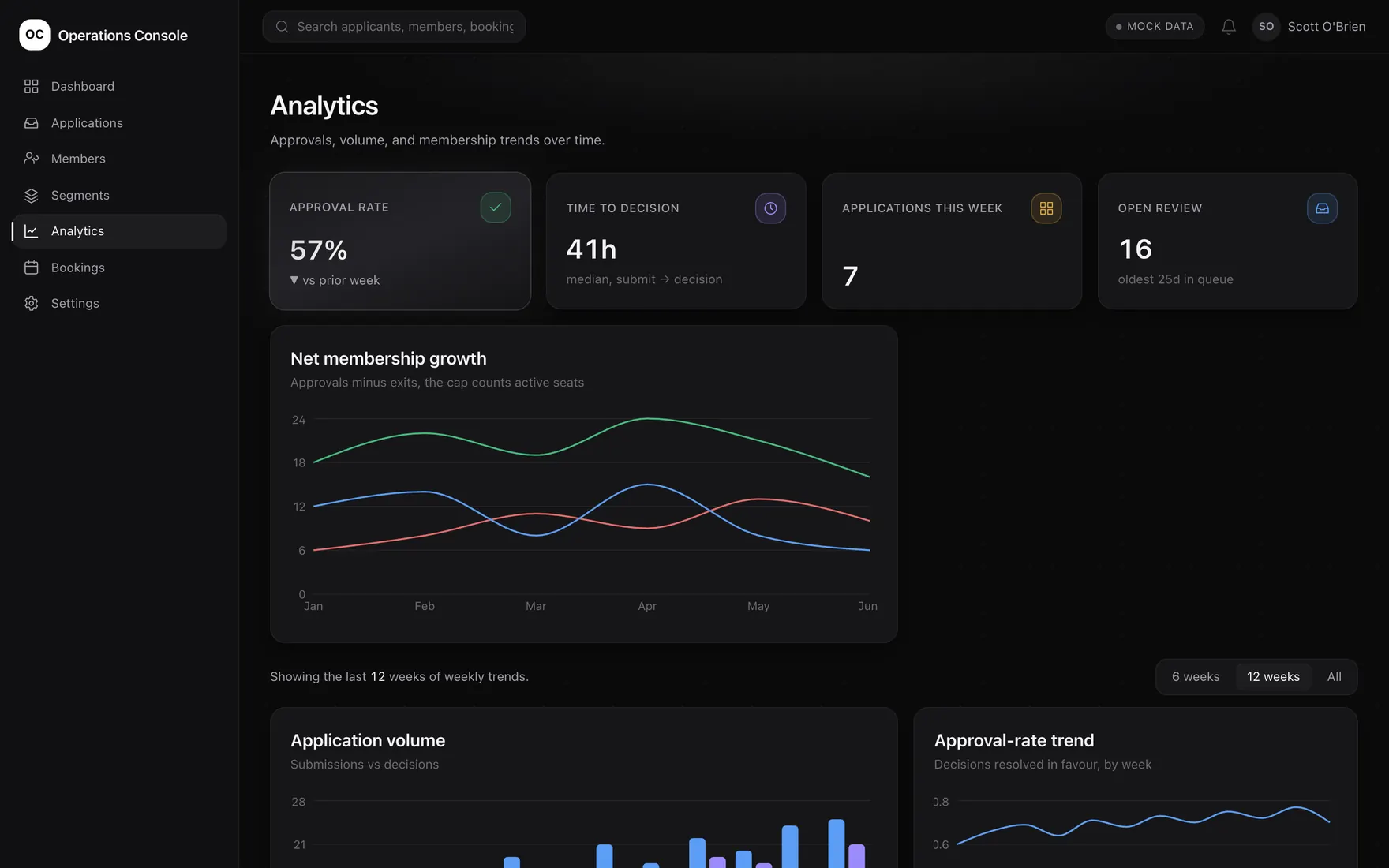
A reporting console showing revenue and volume trends over time, a breakdown by category, and a summary row of headline figures across the top.

Interface shown running on demo data

Business intelligence

The numbers an owner will actually open on Monday morning

Problem

Reporting meant rebuilding the same spreadsheet every week, and two tools rarely agreed on the same number.

System

One source of truth, fed directly from the systems where the work happens, with the figures that drive decisions on the first screen.

Outcome

Numbers update on their own, trends stay visible over time, and nobody reconstructs a report by hand to answer a question.

Explore system
  • Data model
  • Scheduled aggregation
  • Dashboards

How a reminder actually travels

  1. Someone fills in the form
  2. Their record is created or matched
  3. Details are checked before anything sends
  4. The system works out when to reach them
  5. A text goes out at the right time
  6. Their reply comes back in
  7. The record and the team's board both update
  • Consent required
  • Quiet hours
  • Rate limits
  • Duplicate protection
  • Opt-out honoured
  • Audit log

Every message passes all six checks before it is allowed to send.

Client operations

A reminder engine that replaces the spreadsheet chase

Problem

Chasing people for the next step was a manual job somebody had to remember to do, tracked in a spreadsheet.

System

Intake feeds a single client record, a timing engine decides when to reach each person, and messages send inside strict safeguards.

Outcome

The chase runs itself, replies land back on the record, and the team sees only the ones that need a human.

Explore system
  • Intake
  • Scheduling engine
  • Messaging
  • Audit logging

How Veris fits

Keep the systems that work.
Build the layer that's missing.

Tools your business already uses

  • Your CRM
  • Marketing platform
  • Forms and intake
  • Email and calendar
  • Accounting
  • Messaging provider
  • Payments
  • Existing databases
  • Spreadsheets

Veris system layer

  • Data model
  • Business logic
  • Automation
  • AI where it earns its place
  • Workflow
  • Permissions
  • Audit logs

What your team gets

  • One client record
  • Automated follow-up
  • Alerts that matter
  • Dashboards
  • Actions written back
  • Recommendations
  • Reports

We don't replace software simply because something newer exists. We connect what already works, and build custom infrastructure where off-the-shelf tools stop fitting the business.

Capabilities

Four things we do, and why each one pays

Every engagement is some combination of these. We name which one moves your numbers before we build anything.

01

Automate

Remove repetitive operational work so payroll hours go to work that earns, not work that maintains.

  • Lead routing
  • Notifications
  • Document processing
  • Follow-up
  • Report generation
  • Client reminders
  • Handoffs
  • Data entry
02

Connect

Make the systems you already pay for talk to each other, so one record is true everywhere.

  • CRM
  • Forms
  • Email
  • SMS
  • Databases
  • Accounting
  • Ad platforms
  • Project management
03

Intelligence

Use AI only where judgment adds value, so your team spends attention on decisions instead of sorting.

  • Classification
  • Summarization
  • Prioritization
  • Document interpretation
  • Recommendations
  • Knowledge retrieval
  • Exception detection
  • Agent workflows
04

Build

Create the internal software that generic tools cannot fit, so the process stops bending around the product.

  • Dashboards
  • Portals
  • CRM layers
  • Internal tools
  • Specialized applications
  • Industry-specific software

How we work

Small. Working. Proven.
In that order.

Understand

Map how the operation actually works, including the parts nobody wrote down.

Design

Identify the bottleneck with the most leverage behind it, and scope the smallest system that clears it.

Build

Deploy one real system into the business and get it in front of the people who will use it.

Improve

Watch how it gets used, measure what changed, and expand only where the result justifies it.

You should see something useful working in your business before you commit to a large transformation.

Security and control

Business-critical systems require more than a good demo

Automation becomes valuable only when it operates inside clear boundaries. We design around controlled access, traceable actions, human oversight and separated client data.

Controlled access

Systems receive only the permissions their function requires, and nothing beyond it.

Auditability

Important automated actions are logged, so you can trace what happened and when.

Human oversight

High-impact actions can stay behind an approval gate rather than firing on their own.

Data isolation

Client systems and client data stay separated from one another by design.

Failure safeguards

Rate limits, validation rules, duplicate prevention and kill switches are added where the cost of a mistake is real.

Minimum required access

We don't hand an automated system broad authority over your business because it happens to be convenient.

Veris does not hold SOC 2, HIPAA, PCI or ISO certification, and we will not tell you otherwise to win a project. What we can tell you is exactly which controls are built into your system, and we will walk you through them before anything goes live.

Business outcomes

Technology only matters if the business gets better

Less manual work

Repetitive administrative tasks stop consuming hours you are already paying for.

Faster follow-up

Actions fire when a business event happens, not whenever somebody next checks.

Better visibility

Operational data lands in one clear view instead of five tabs and a spreadsheet.

Fewer missed handoffs

The next step stops depending on one person remembering to take it.

Better decisions

Exceptions and priorities surface on their own, rather than managers going looking.

Connected data

Two tools stop reporting two different numbers for the same question.

Fit

Built for companies where operational complexity is becoming expensive

We would rather be straight with you on a first call than six weeks into the wrong project.

A good fit

  • Growing service organizations with real operational volume
  • Important information spread across several tools
  • Revenue that depends on how fast you follow up
  • Teams rebuilding the same reports by hand
  • Processes that run on spreadsheets or on memory
  • Workflows specific enough that generic software never quite fit

Not the right fit

  • AI bought for novelty, with no problem attached to it
  • Shopping purely for the cheapest developer
  • Pre-revenue ideas with no validated operation to build on
  • Work that needs a staffed agency on call around the clock
Scott O'Brien, founder of Veris AI.

The operator behind it

Built by an operator who learned to engineer systems

Veris AI started from a simple observation: most automation problems are not really AI problems. They are operational problems.

Understanding how leads move, where handoffs break, why people repeat the same work and where information quietly disappears matters far more than which model you pick. That is why Veris starts with the business and builds outward from there.

I'm Scott O'Brien. I run Veris, and I stay close to the implementation on every engagement. The person who sits in your discovery call is the person who maps your operation and writes the code, so nothing is lost in a handoff and you never explain your business twice.

  • Senior involvement on the work itself, not just the sales call
  • No handoff between the person who sells it and the person who builds it
  • I'll tell you when the answer is no, on the call, for free
  • I stay after it ships, because systems meet reality the day real people use them

Newport Beach, California. Speaking and workshops.

Where things actually stand

Real systems. Real deployments. Honest status.

Veris is early and takes on few clients at a time. Rather than borrow credibility we have not earned, here is exactly where the work sits today.

In production

A public events platform, with its calendar, event integration and speaker submission flow.

In active build

A sales CRM with an agent layer, a client reminder and intake engine, and a revenue attribution product.

On measured results

We will publish before, system and after when we can show you the source of every number. We will not publish numbers we cannot stand behind.

On client names

We describe what was built, never who it was built for, until a client tells us in writing that we may name them.

Let's find the part of your operation that shouldn't still be manual

We'll look at how the work happens now, what software you already use, and where better infrastructure would create measurable leverage.

No pitch deck required.

  • We ask how the work happens today, and where it breaks.
  • We tell you which part is worth automating first, and why.
  • If technology is not your problem, we say so on the call.